What are the top 10 cruise questions asked on social media? Social Media is a treasure trove of information. You can find out the answer to almost anything that comes to mind. However, laziness kicks in and instead of people actively researching their own wants and needs, they jump online and simply ask a generic question “What’s the best cruise for me?” Well that depends on what you are looking for.
No backstory, no details, just a generic question. Which means you are going to get generic answers and in some social platforms you are going to get misinformation.
Looking across social platforms here are the 10 most asked cruise questions answered honestly, without the guesswork or misinformation. Whether you are a first-time cruiser or just starting your planning process, hopefully these can help.
First-Time Cruiser Series: This is the main guide in my first-time cruiser series. Each question below gives you a simple answer, with links to deeper guides when you want more detail.
What Cruise Cabin Should You Book?
This is the question that keeps first-time cruisers up at night, and honestly, the answer is simpler than the cruise line website makes it look.
Start with your budget and work from there. Inside cabins are the most affordable and perfectly comfortable. You are on a ship. The whole ship is your living room. You do not need a window to have a great time, and plenty of experienced cruisers still book inside cabins on purpose because they would rather spend that money on excursions or a nice dinner.
Oceanview cabins give you natural light and a peek at the water. Balcony cabins are the sweet spot for most people who want that fresh air and a private outdoor space. If you are cruising somewhere scenic like Alaska or Norway, a balcony is worth every penny.
Suites are a different vacation entirely. Private areas of the ship, priority boarding, butler service on some lines. Wonderful if that is your budget.
Pro Tip: Location on the ship matters. Mid-ship cabins on lower decks move the least if you are prone to motion sickness. Avoid cabins directly under the pool deck unless you enjoy the sound of deck chairs being dragged at 6 a.m.
Want a deeper breakdown of inside, ocean view, balcony, and suite cabins?
Read the full cruise cabin guideNow that the sleeping arrangements are sorted, let’s look at what your cruise fare actually includes.
What Is Included in a Cruise Fare?
Here is where new cruisers get tripped up. The brochure price sounds incredible until you realize what is not in it.
Your cruise fare covers your stateroom, main dining room meals, buffet access, and basic beverages like water, coffee, tea, and limited juices. Most onboard entertainment is also included, things like Broadway-style shows, deck parties, trivia nights, and the pools.
What costs extra? A longer list than most people expect. Specialty restaurants, alcoholic drinks, soda, Wi-Fi, gratuities, spa treatments, and shore excursions are almost always add-ons. Some cruise lines also charge for certain fitness classes, room service (beyond a basic continental breakfast), and premium ice cream or coffee bars.
The smartest thing you can do before you board is look at your cruise line’s website and find the exact list of inclusions for your ship and sailing. Lines like Virgin Voyages bundle gratuities and Wi-Fi. Norwegian, Royal Caribbean, and Carnival have different structures entirely.
Knowing this ahead of time means you budget correctly and you do not have a minor heart attack when you see your onboard account the night before you disembark.
Want to dig more into your cruise fare?
These cruise questions answered so far cover the basics. Now let’s get into the ones that tend to surprise people.
How Much Should You Tip on a Cruise?
Gratuities on a cruise are not exactly optional, even when they look like they are.
Most major cruise lines add automatic daily gratuities to your onboard account. In 2024 and 2025, those rates typically run between $16 and $20 per person per day depending on the cruise line and cabin category. Suite guests usually pay a higher rate. This money is pooled and distributed among your cabin steward, dining staff, and other crew members who work behind the scenes and never appear on your radar.
You can technically remove these gratuities at guest services, but the crew depends on that income. It is not a good look, and most experienced cruisers would tell you not to do it.
Additional tipping:
If your bartender is consistently excellent, a dollar or two per drink is appreciated. Same goes for your cabin steward or a waiter who went out of their way for you. This is not required, but the crew works incredibly hard, and a small amount of cash goes a long way.
Specialty restaurant gratuities are sometimes added automatically as well, so check your receipt before you add more.
Personal Note on Tipping:
This is one of the most confusing costs when discussing cruise fares with clients. Each cruise line handles them differently. However, as a family we always bring a small amount of cash with us, in small bills to tip those crew members that make our trip that much more enjoyable. Bartenders, kids club workers, wait staff, it doesn’t matter. We like to show our appreciation by giving them a little something over the prepaid gratuities.
With gratuities covered, it makes sense to look at what most people are wearing while they wander the ship.
Want to learn more about tipping?
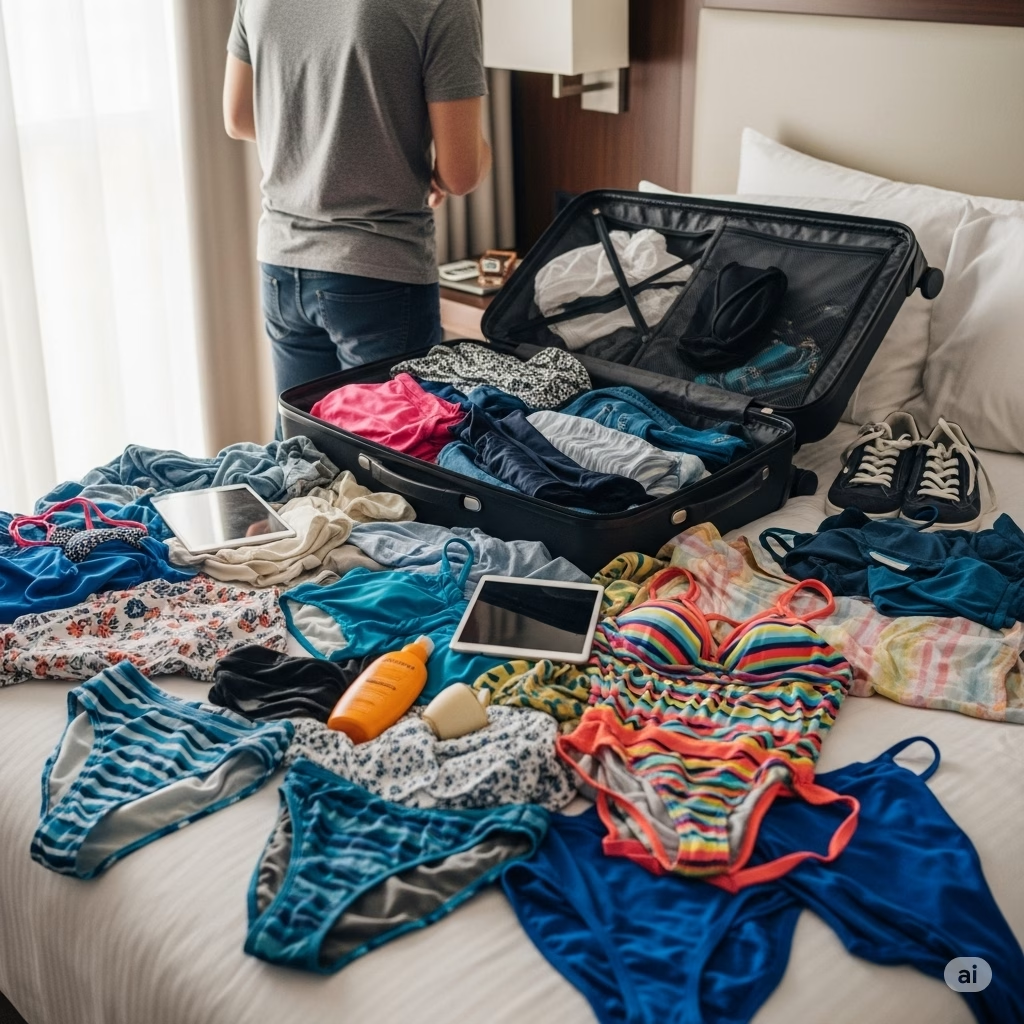
What Should I Wear on a Cruise?
Good news: you do not need a formal wardrobe, and nobody is walking around in a tuxedo anymore (well, almost nobody).
During the day, pack casual and comfortable. Shorts, t-shirts, sundresses, swimwear, and a light layer for air-conditioned spaces work perfectly. Bring a pair of comfortable walking shoes for port days because cobblestone streets in the Caribbean or Europe will destroy you in flip-flops.
In the evenings, it depends on the cruise line. Most lines have a range of nights from casual to “smart casual” to formal. Smart casual means you look like you tried a little bit. Nice jeans, a blouse, a collared shirt, that kind of thing. Formal nights on traditional lines like Cunard or Princess still call for cocktail dresses and suits. On lines like Virgin Voyages or Norwegian, the dress code is much more relaxed.
Specialty restaurants on most ships require at least smart casual attire. They will sometimes turn you away if you show up in a tank top and flip-flops, which would be a sad end to what should be a great dinner.
Pack for layers. Ships run cold inside. The pool deck runs hot. You will be doing both in the same afternoon.
Clothing handled, the next big question is usually travel documents.
Worried about what to wear?
Do I Need a Passport to Cruise?
The short answer is: you do not always need one, but you should get one anyway.
For closed-loop cruises, meaning you depart from and return to the same U.S. port, U.S. citizens can technically travel with just a birth certificate and a government-issued photo ID. Cruises from Miami, Fort Lauderdale, Galveston, and similar homeports often fall into this category.
Here is the problem with going that route: if a medical emergency happens during your cruise and you need to fly home from a foreign port, you cannot board an international flight without a passport. You would be stuck, stressed, and dealing with a consulate while also dealing with whatever the emergency is. That is not a situation anyone wants.
A passport also makes every port stop smoother. Some destinations are adding entry requirements that a birth certificate will not satisfy.
⭐Bottom line:
Get the passport. It is valid for 10 years, it opens up every travel option you will ever need, and the peace of mind is worth the $130 or so it costs to get one. If your cruise is coming up fast, look into passport expediting services.
Once the paperwork is in order, Wi-Fi is often the next thing people worry about.
Do I need a Passport?
Is Cruise Wi-Fi Worth Buying?
This is one of the most debated questions in every cruise Facebook group on the internet, and the answer is genuinely: it depends on you.
Cruise ship Wi-Fi has improved a lot in the last few years. Lines like Royal Caribbean (with Starlink on many ships) and Celebrity now offer speeds that are actually usable for video calls and streaming. Other ships are still running internet that feels like it is powered by a hamster on a wheel.
If you need to stay reachable for work, check email, message family, or browse the web, a basic Wi-Fi package may be enough. If you want to make video calls, stream, upload large files, or use apps that need stronger bandwidth, you will usually need the higher-tier internet package.
If you are trying to truly disconnect, skip it. The ship will not sink because you missed Instagram for a week.
💲Pro tip:
Your cruise line will dictate when you should purchase your Wi-Fi. For example, Norwegian Cruise Line will give you each 150 minutes of free WIFI when you book the Free at Sea. If you wait until Day 2, you can buy the WIFI at a discounted price and add streaming.
One device or multiple devices matters too. Read the fine print on what your package actually covers before you assume your partner is included.
After staying connected, the next question is usually about what you can actually drink without opening your wallet.
Do I really need Wi-Fi
What Drinks Are Included on a Cruise?
More than you might think, but probably not what you are hoping for.
Always included on most cruise lines: water, coffee, hot tea, milk, and some juices at breakfast. Iced tea and lemonade are often available at the buffet as well. These are not glamorous, but they are free and available around the clock.
Not included on most lines: alcohol, soda, specialty coffee drinks, smoothies, fresh-squeezed juices, energy drinks, and anything that sounds exciting on a menu.
Drink packages are the big question. If you plan to drink regularly, a beverage package often pays for itself by day two. Most packages run between $60 and $100 per person per day depending on the cruise line and what is included. The catch is that most lines require both adults in a cabin to purchase the same package, so you cannot have one person buy it and share.
Do the math before you board. Add up what you would realistically spend per day on drinks, compare it to the package price, and make the call from there. Your bar receipts will thank you either way.
Before you start packing, it helps to know what is allowed onboard.
What you can actually drink without opening your wallet.
What Can I Bring Onboard a Cruise Ship?
More than you can carry, probably less than you want to pack.
Cruise lines are fairly reasonable about personal belongings. Clothes, toiletries, medications, sunscreen, books, small snacks, and non-alcoholic beverages are generally fine. Most lines allow you to bring a bottle or two of wine to celebrate a special occasion, though rules vary.
What they restrict:
irons and steamers (fire hazard), certain power strips with surge protectors, candles, heating pads, and in some cases certain electrical appliances. Bring a power strip without a surge protector if you need extra outlets, or a multi-USB charging hub, and you will be fine.
Alcohol:
Do not assume you can bring alcohol onboard. Each cruise line has its own policy. Some allow a limited amount of wine or champagne in your carry-on bag. Some limit it by adult passenger. Others limit it by cabin. Hard liquor, beer, and hidden alcohol are usually prohibited and may be confiscated.
Before you pack wine or champagne, check your exact cruise line’s alcohol policy for your sailing. The rule can depend on the cruise line, embarkation port, bottle size, and whether it is packed in your carry-on or checked luggage.
Medications:
Bring more than you need in your carry-on, not in your checked luggage. If your bag goes to your cabin late and you need that medication, you will be glad you kept it with you.
Before you pack:
Spend ten minutes on your cruise line’s website looking at their prohibited items list. It varies by line. What Royal Caribbean allows, Carnival may not, and nobody wants their corkscrew confiscated at the gangway.
With the suitcase sorted, the next question is often which cruise line is the best fit.
Not sure what you can bring onboard?
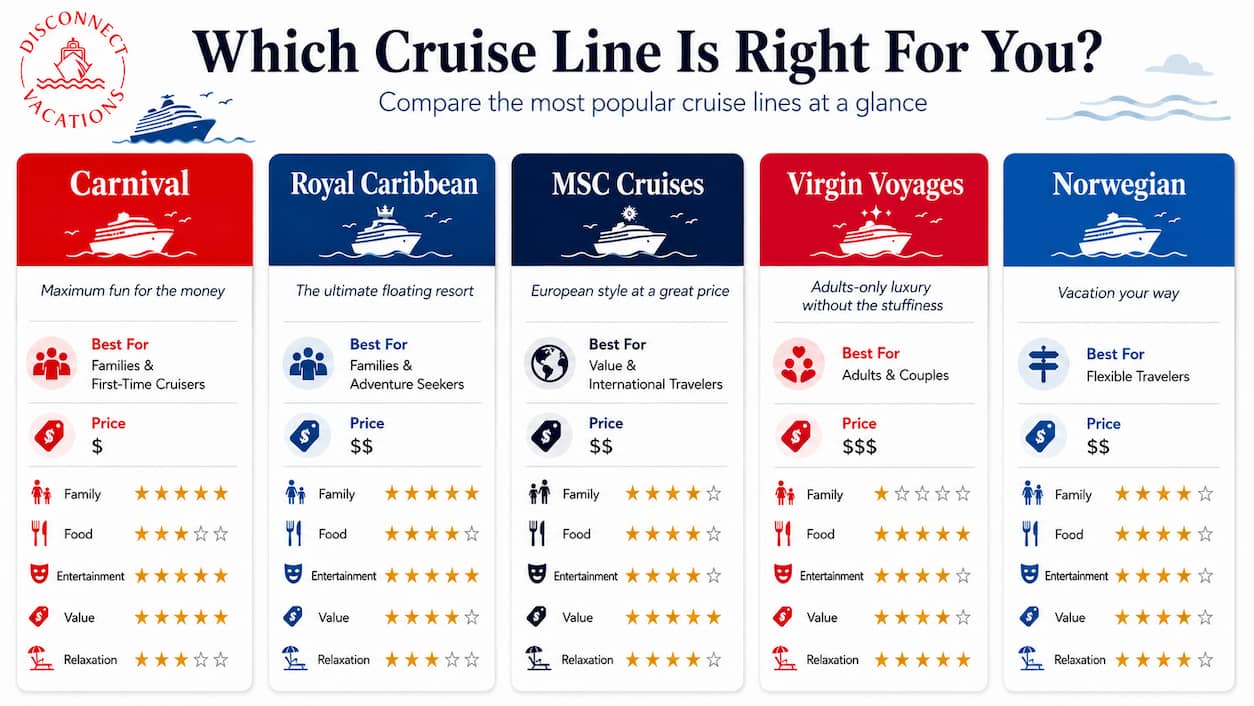
What Is the Best Cruise Line for First-Time Cruisers?
There is no single right answer here, which is the most honest thing a travel advisor can tell you.
The best cruise line for a first-timer is the one that matches how you like to vacation.
Royal Caribbean is a strong all-around choice. Big ships, tons of activities, a wide range of cabin prices, and itineraries everywhere. If you want the full cruise experience with waterslides, rock climbing walls, and Broadway shows, this is a great starting point.
Carnival leans fun and social with a younger crowd and a party atmosphere. Great value, especially if budget matters.
Norwegian Cruise Line has a more freestyle approach where you eat when you want and dress how you want. Good for people who do not like scheduled dining.
Princess and Holland America run a quieter, more classic cruise experience. Better fit if you want a more relaxed pace and an older demographic.
Disney Cruise Line is exceptional for families with kids and genuinely impressive for adults too, though you will pay more for it.
Celebrity Cruises sits in a sweet spot between mainstream and luxury. Beautiful ships, excellent food, and a slightly more refined atmosphere without the intimidating price tag of true luxury lines.
My honest advice: tell a travel advisor ( Hi That’s Me! ) what you like to do on vacation, who is traveling with you, and where you want to go. The right cruise line will become obvious quickly. If you are still unsure you can test out the complimentary Cruise Vibe Finder!
Once you choose the right cruise line, the last step is knowing what to expect before you sail.
What Should You Know Before Your First Cruise?
A few things nobody tells you that would have saved a lot of people a lot of stress.
Arrive the day before you sail.
Flights get delayed. Traffic happens. If you miss your ship, it will not wait for you, and the port is not going to reimburse your ticket. Book a hotel near the port and start your vacation relaxed instead of terrified.
Pack a carry-on with your essentials.
Your luggage may not reach your cabin until mid-afternoon. Bring your medications, a change of clothes, your swimsuit, and your travel documents in a bag that stays with you at embarkation.
Learn the ship before you need to.
When you board, walk around. Find the dining rooms, the medical center, your muster station, and the guest services desk before you need any of them in a hurry.
Book excursions and packages early.
Popular shore excursions sell out. Drink packages and specialty dining are almost always cheaper before you board than after. MOST!
Seasickness is real and manageable.
If you are worried about it, pick up some Bonine or Sea-Bands before you leave. Ginger chews work for some people. The ship’s medical center can also help, but prevention is easier than the cure. Also keep in mind that they do not accept health insurance.
The last night matters.
Put your luggage out the night before disembarkation if your cruise line uses that system. Review your onboard account. Handle any billing questions before you get in the disembarkation line, because that line is not the place to argue a charge. ALWAYS double check your account portfolio.
In Closing
These are the questions most cruisers ask, but each one deserves a deeper look. Over the coming weeks, I will break these topics down one by one so you can plan your cruise with confidence. There is so much information out there and my plan is to at least provide a central spot with accurate answers. Make sure to check back and visit the blog in the coming weeks.